
Technical resource 11 min read Updated
Anchoring Inflatable Cinema Screens — Pegs, Water Anchors and Wind
How to anchor an inflatable cinema screen properly — where the anchor points are, pegs by ground type, water-fillable anchors on hard stands, how much ballast, and the wind plan that decides whether you screen at all.
An inflatable screen is a sail. A 6 m screen presents 30-plus square metres to the wind, and inadequate anchoring is both the most common cause of a screening going wrong and the biggest safety risk on site. It is also entirely manageable — with the right ballast, a 45° spread and a decision made in advance about when to stop.
Why a bit more breeze is a big deal
Wind load does not rise in a straight line. It scales with the square of the wind speed, so going from 15 km/h to 30 km/h roughly quadruples the force on the screen. That is why a setup that felt rock solid at lunchtime can be in trouble by sunset on a building sea breeze, and why you plan around the gust figure rather than the average.
Know your anchor points
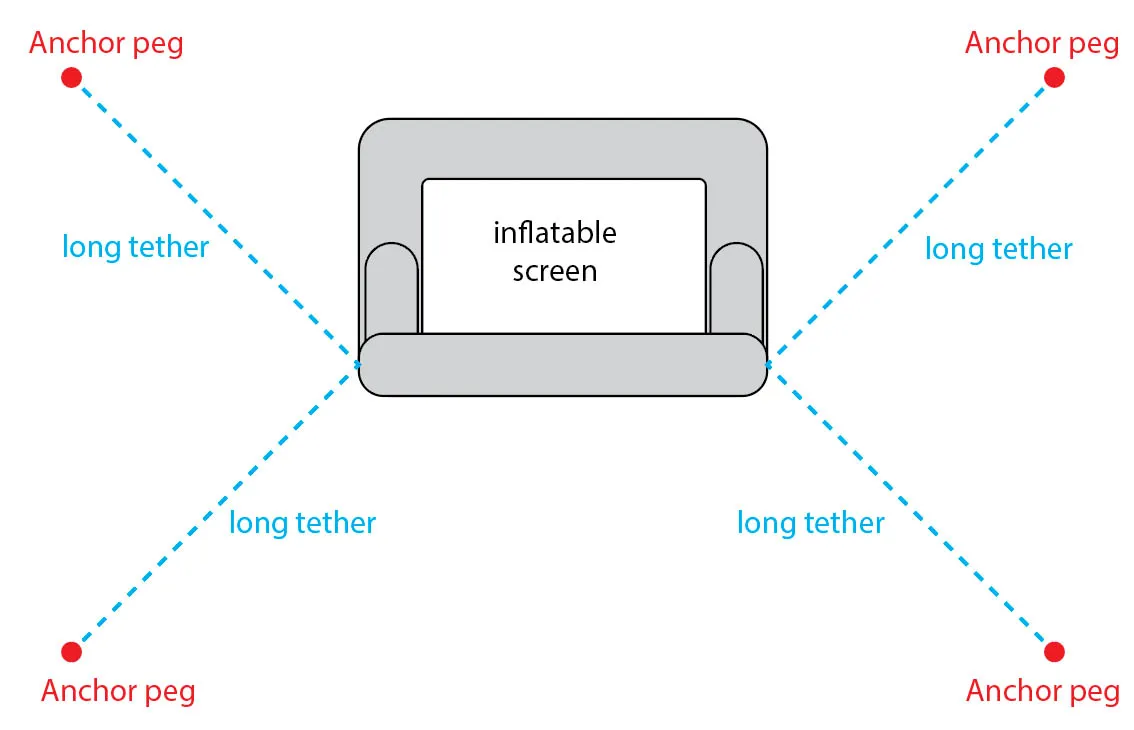
Find them before you need them. An A-frame screen typically has six anchor points — D-rings, three on each side of the frame. The four long tethers attach to the top anchor points; the short tethers add security lower down.
- Use every anchor point the screen provides, loaded evenly. Two taut tethers and two slack ones is not four anchors, it is two.
- Anchor to rated points only. Never to fabric tabs, the screen surface, or a convenient handle. Rated points are built into the frame’s load path; nothing else is.
- Spread the long tethers at roughly 45°. That angle gives the best mix of downward and outward hold. Much steeper and you are pulling the screen down more than back; much shallower and you need far more ground length and get less resistance to lift.
Pegs — the grass method
On turf and soft ground, pegs are fast, effective and cheap.
- Angle them leaning away from the screen, so tension pulls the peg deeper into the ground rather than levering it out. A peg driven straight down, or worse leaning towards the screen, will walk out under load.
- Match the peg to the ground. Soft turf and sand need longer pegs, or a buried deadweight — a short peg in sand holds almost nothing. Hard-packed ground holds well but is punishing to drive into; take a proper hammer, not the mallet from a camping set.
- Check what’s under you. Irrigation, cabling and services live just below sports fields and civic lawns. Ask the venue before you drive anything in — this is a standard question and grounds staff will have the answer.
- Re-check after an hour. Pegs settle, tethers stretch slightly, and the tension you set at bump-in will not be the tension you have at showtime.
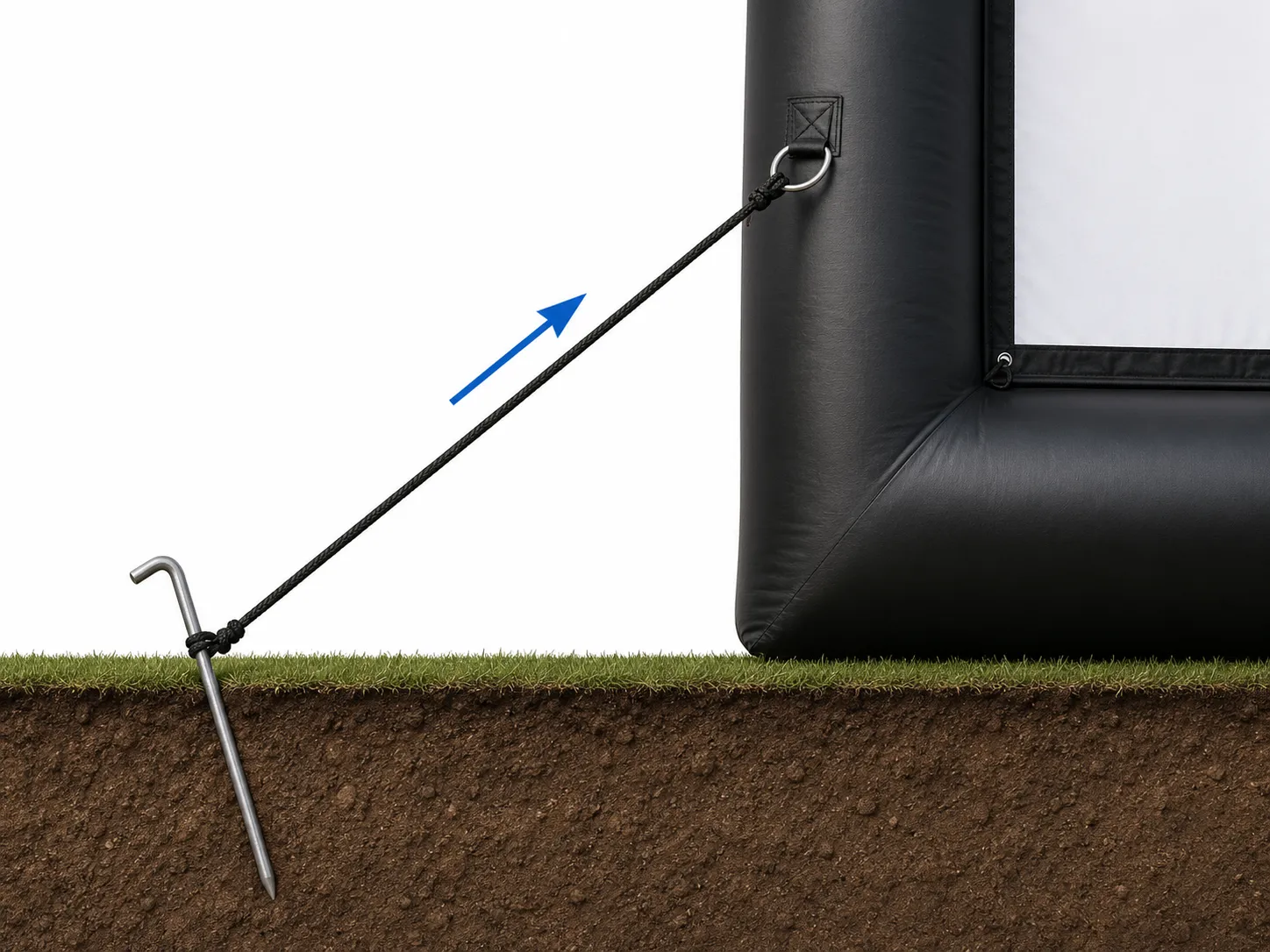
The peg leans away from the screen so the pull drives it deeper; the tether runs at roughly 45° to a rated anchor point.
Water anchors — the hard-stand method
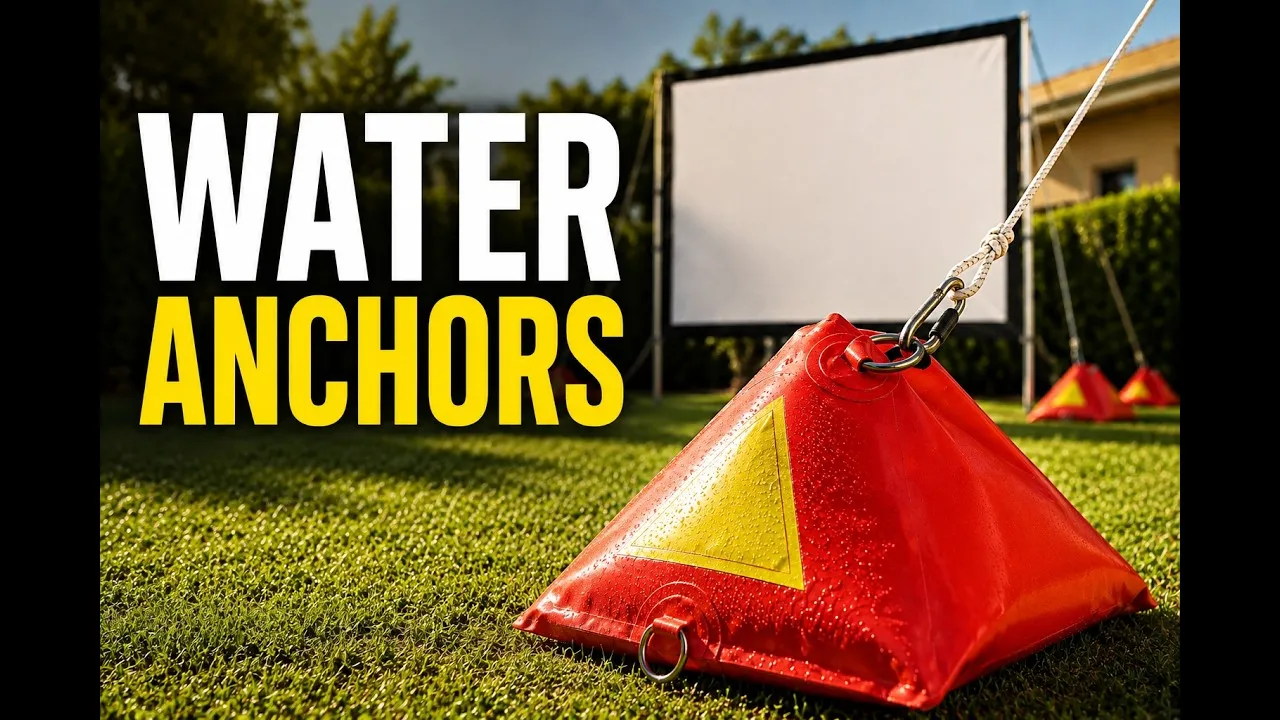
Water-fillable PVC anchors are the answer wherever pegs are banned or useless: car parks, netball and tennis courts, paved squares, school hardstands, rooftop terraces, irrigated turf that the venue won’t let you pierce, and anywhere with services underground. They empty for transport and fill on site, which is the whole point — you carry almost nothing and end up with real ballast.
Our range is 40 kg and 80 kg capacity, sold singly or in sets of four, in heavy-duty UV-stable PVC with a built-in tether point.
Practical detail that nobody writes down but everybody learns the hard way:
- Bring a hose and a bucket. Taps are often further away than you expect, and a bucket is the difference between filling four anchors and giving up on two.
- Allow about ten minutes to fill a set of four, and do it early — it is a job for the start of bump-in, not five minutes before doors.
- Position them where you can drain downhill at pack-down. Emptying 80 kg of water uphill, in the dark, at 11 pm, is a mistake you make exactly once.
- Don’t monopolise the tap the caterer or the coffee van needs. Ask first; it costs nothing and buys goodwill.
- Put something under them on turf if the ground is soft — a filled anchor left overnight will leave a mark on a bowling green.
How many, and how heavy
Most inflatable screens — ours included — don’t ship with a published ballast figure, so the honest way to size anchoring is from the wind load itself. We estimate it with the standard flat-plate method: ½ × air density × gust speed² × drag coefficient (1.2) across the screen’s whole frontal area (surface plus frame), then double it as a safety margin before converting to ballast. That produces these starting points:
| Screen | Frontal area (approx.) | Wind force (30 / 40 km/h gusts) | Suggested ballast, gusts to 30 km/h | Suggested ballast, gusts to 40 km/h |
|---|---|---|---|---|
| 3 m | ~9 m² | ~45 / ~85 kg | 4 × 40 kg (160 kg) | 4 × 80 kg (320 kg) |
| 4 m | ~14 m² | ~75 / ~130 kg | 4 × 40 kg (160 kg) | 4 × 80 kg (320 kg) |
| 5 m | ~21 m² | ~110 / ~195 kg | 4 × 80 kg (320 kg) | 4 × 80 + 2 × 40 kg (400 kg) |
| 6 m | ~30 m² | ~155 / ~280 kg | 4 × 80 kg (320 kg) | 8 × 80 kg (640 kg) |
| 8 m+ | 45 m²+ | ~235 / ~415 kg+ | 6 × 80 kg (480 kg) | Talk to us — plan the site properly |
Read the table with these in mind:
- Minimum four anchors, one per corner tether, whatever the screen size.
- Load every anchor point the screen provides, evenly.
- Anchors don’t have to be filled to capacity. An 80 kg anchor filled to 60 kg gives you 60 kg of ballast — and since they travel empty, many operators simply standardise on 80 kg anchors and fill to what the day needs. Capacity is headroom, not obligation.
- Pegs count too. Treat a well-driven 400 mm peg in firm turf as roughly one 40 kg anchor, and halve that in soft or wet ground. Pegs and weights combine towards the same totals.
- Scale with exposure. A 4 m screen on a sheltered school oval and the same screen on an exposed coastal reserve are different problems. Windier site means more ballast, not the same ballast held more optimistically.
A guide, not a guarantee
These figures are conservative estimates from standard wind-load calculations, not site-specific engineering advice. Real conditions vary — ground, gust behaviour, exposure and the condition of your equipment all matter, and anchoring remains the operator's responsibility. When in doubt, add ballast, reduce exposure, or bring the screen down. Running an exposed or large-scale site? Talk to us before the event, not after.
Sites that catch people out
- Coastal and elevated ground. An afternoon sea breeze arrives on schedule and builds through the evening, exactly as your audience is sitting down.
- Gaps between buildings. Wind funnels and accelerates through them. A site that is calm either side of a gap can be unusable in it.
- Large open reserves. Nothing slows the wind down; whatever is forecast is what you get.
- Anywhere your forecast is for the nearest town, not the site. Ridge lines, water and open paddocks all change the number.
The wind plan
Decide this before you leave the depot, not while you are watching the screen move.
- Check the forecast the day before and again on the day — both wind speed and gust speed. Gusts are what break things.
- Know your limit and write it down. Every inflatable has a maximum safe wind rating; for many event screens that is in the order of 30–40 km/h. Use your screen’s figure, not a general one, and have it on the run sheet so the decision isn’t yours alone to argue at 7 pm.
- Read the conditions on site. Without an anemometer: leaves and small branches in constant motion, dust picking up, or whitecaps on water is roughly 30 km/h and rising — time to be cautious. A cheap handheld anemometer costs less than one damaged screen surface.
- Anchor before full inflation, and re-check tension and ballast before the audience arrives.
- Have a call point and a plan B. Agree in advance who makes the call, at what wind speed, and what happens then — deflate and switch to a smaller screen, move indoors, or cancel. No film is worth an injury or a destroyed screen.
When in doubt, bring it down
Deflating takes minutes and is completely reversible. Every other outcome of leaving an under-anchored screen up in rising wind is not.
Paperwork councils and venues ask for
If you run events for councils, schools or commercial venues, you will be asked for some or all of this. Write it once and reuse it:
- Public liability insurance certificate of currency.
- A safe work method statement (SWMS) covering setup, operation and pack-down.
- An anchoring method statement — what the screen is, its sail area, how it is secured on each surface type, what ballast is used, and the wind speed at which you shut down.
- Site plan showing the screen, anchor positions, cable runs and audience area.
Venues rarely audit the detail, but not having it is a common reason a booking stalls.
The gear that does the job
Proper anchors and blowers are cheap insurance against an expensive and dangerous failure. On very exposed, coastal or elevated sites, consider whether a rigid fast-fold screen or an LED wall is simply the better tool — see choosing a projection screen and LED vs projection.
Setting the screen up in the first place is covered step by step in how to set up an inflatable cinema screen.
Watch it done
Common questions
How much weight do I need to anchor an inflatable movie screen?
Most inflatable screens don't ship with a published ballast figure, so work from the wind load. As a starting point from our estimates, four 40 kg anchors suit a 3–4 m screen in gusts to about 30 km/h; step up to four 80 kg anchors for stronger gusts or a 5–6 m screen, and add anchors as size and exposure grow. Use every anchor point, err on the side of more ballast, and reduce exposure or bring the screen down rather than push a limit. Our anchors come in 40 kg and 80 kg capacities and don't have to be filled to the top — fill to the ballast the day needs.
Can I use an inflatable screen on concrete or asphalt?
Yes, but you cannot peg it. Use water-fillable or concrete ballast weights on every anchor point instead. This is the normal arrangement in car parks, on courts and on paved civic squares, and it is why most operators carry a set of water anchors even if they usually work on grass.
What wind speed is too much for an inflatable screen?
As a general rule inflatable screens should not be used above 40 km/h, and many event screens are rated in the 30–40 km/h range. Use your screen's own figure, plan around forecast gusts rather than the average, and remember the picture becomes unwatchable well before the screen is at risk.
Do I anchor before or after inflating?
Before. Attach tethers and set pegs or weights while the screen is flat or only part-inflated. A gust during inflation, when the screen is presenting its full area and nothing is holding it, is the moment things go wrong.
What paperwork do councils and venues ask for?
Commonly public liability insurance, a safe work method statement covering setup and pack-down, and a short anchoring method statement describing how the screen is secured, on what surface, with what ballast, and at what wind speed you will shut down. Having these written once and reusable makes bookings much easier.
Planning an outdoor screen or LED installation?
Tell us about your site and audience. We scope, supply and support outdoor cinema and permanent LED systems Australia-wide.